
Fast forward to this year––I happened to come across the Exemplars website during one of my online quests for enrichment and differentiation for my gifted students. Are these the same Exemplars? The thought that I had found what I had totally forgotten about, yet loved, from years past, excited me. How amazed I was to see rich tasks for every Common Core mathematical standard! I quickly realized that there was a lot more to the Exemplars program than what I had originally known.
Exemplary! A Firsthand Account of the Use of Exemplars Math Tasks in a Fifth-grade Classroom
Dianna James, K-5 Teacher of Neurodiverse Students, CO

Several years ago, I had an opportunity to try out “Exemplars” math tasks. I didn’t know what this was or quite how to use them, but I was willing. At that time, I was a third-grade general education teacher of a gifted and talented cluster classroom, which was also a special education inclusion classroom and an English as a Second Language (ESL) classroom. Needless to say, I had all ability levels in my classroom!
When I came across these Math Exemplars, I wasn’t really sure what to expect or what I was doing. I was just excited to have something different. Because these were “problem-solving” tasks, I had to be careful who I assigned them to. I started using Exemplars with similar-ability partners. At that time, I found that my high-ability students LOVED them; other students, not so much.
"To say I fell in love with Exemplars again is an understatement. Coupled with the students’ excitement came increased math growth and interest."
I chose my fifth-grade gifted and talented cluster classrooms for the Exemplars Ambassador program. These two classrooms are a hodgepodge of students, interests, and abilities. I have students performing two to three grade levels above and two to three grade levels below fifth grade. I spoke with my cluster co-teachers. The initial thought was to try it with the high-ability group. One task in, and we were quickly bringing all students into the mix.
The amount of discussion, productive struggle, and success was overwhelming for us all––students included! I watched my gifted students hyper-focus, overthink, get things wrong, struggle, finally find the right answer, and then ask for more. I watched my grade-level and below grade-level students very apprehensively, dive in, ask for supports, and also find success. I heard cheers and felt the excitement as students solved math problems that sometimes they thought were impossible.
"Students didn’t grumble about Exemplars math tasks, but instead, requested them."
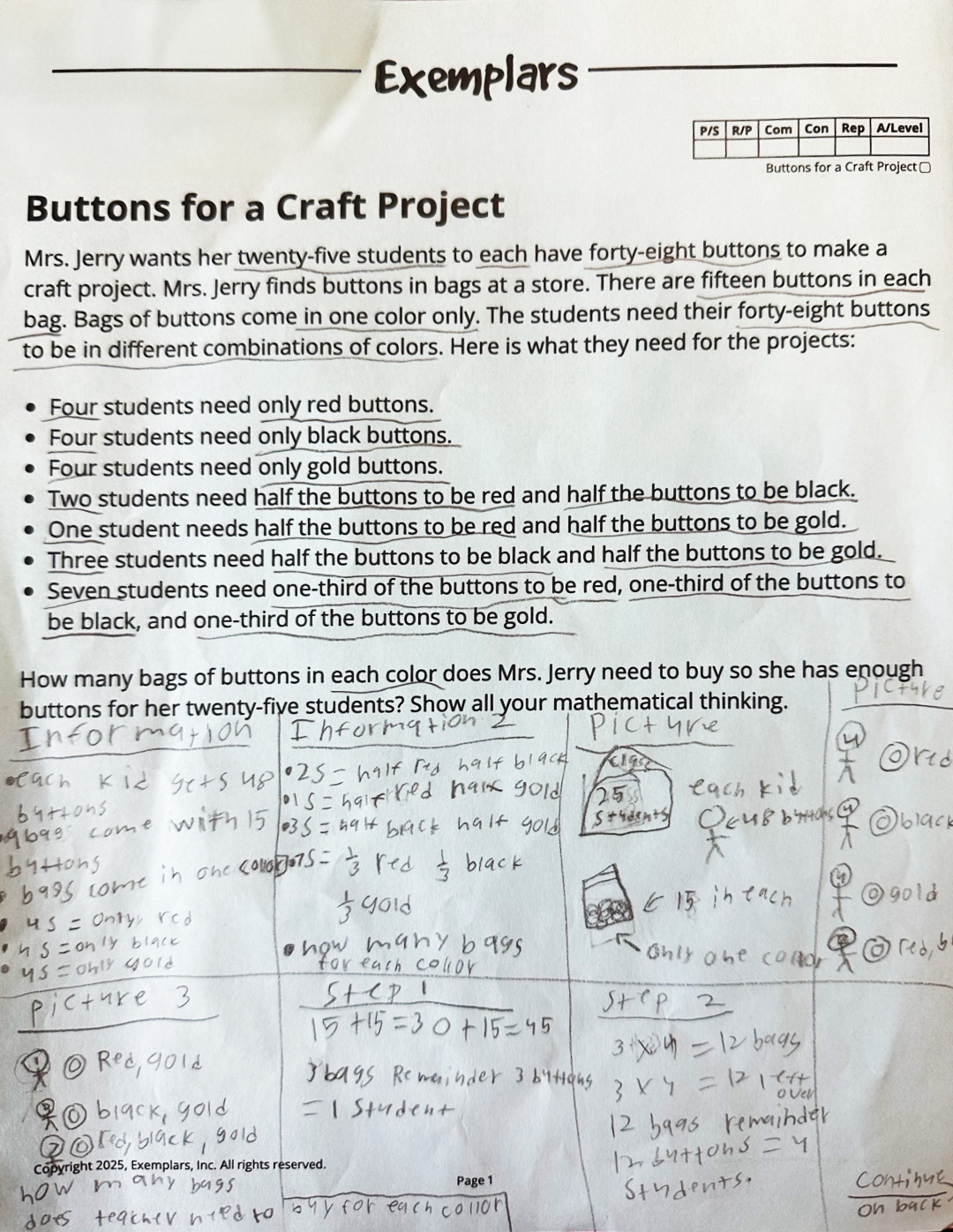
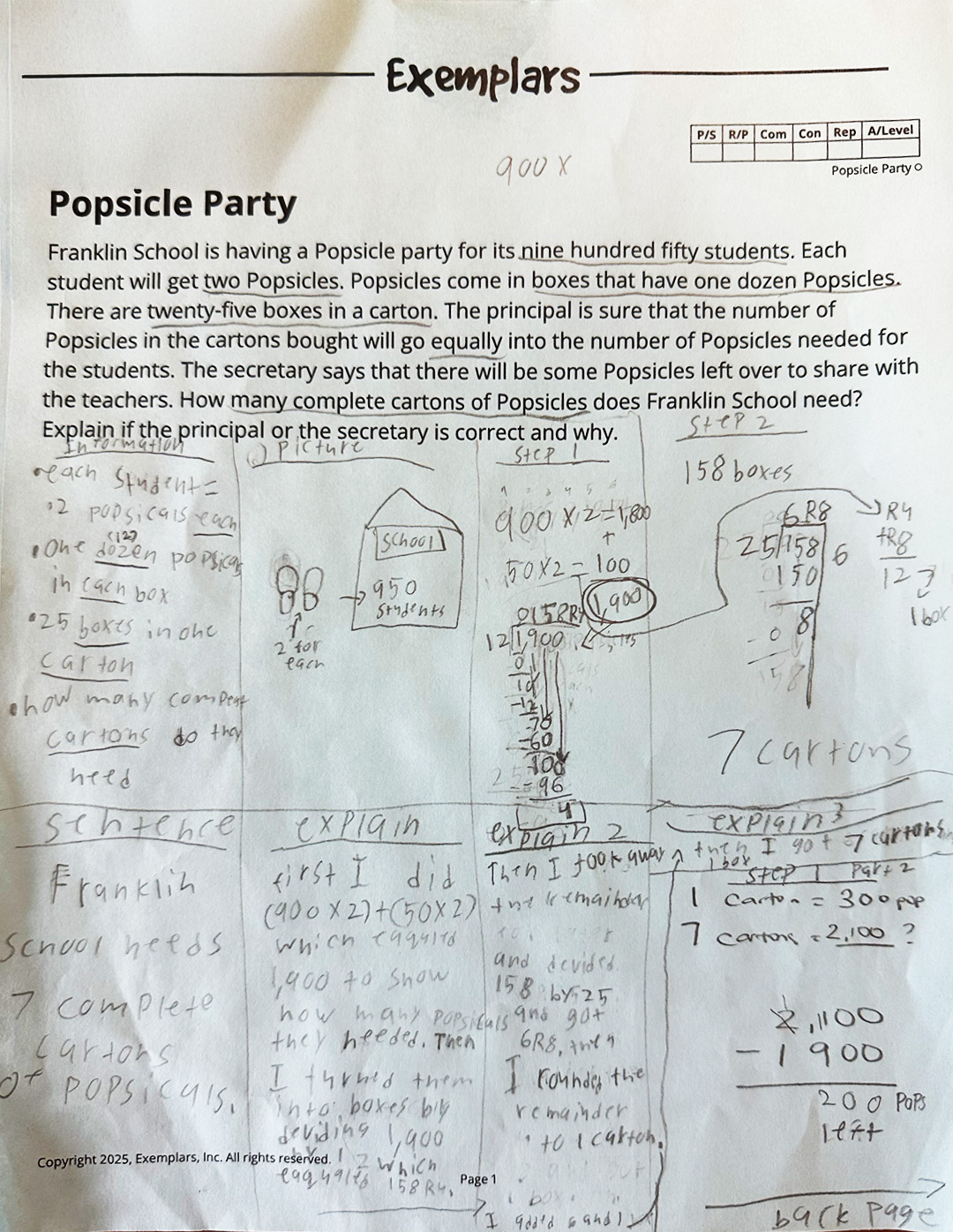
Math Problems. It doesn’t feel right to even call these Exemplars “math problems,” as they are so much more. Exemplars performance tasks are very well-crafted, real-world scenarios with a math component. Students are able to visualize and draw pictures to help them find solutions. They are able to talk about the scenarios and attach meaning to each one. As a math instructor, I have found that being able to attach meaning is overwhelmingly a high predictor of mathematical success. As part of the Exemplars work we did in class, students were challenged to include math talk in their solutions. Students of all levels included math talk on their papers, labeling and organizing their work, as well as including brief (and sometimes not-so-brief) explanations for their work.
To say I fell in love with Exemplars again is an understatement. Coupled with the students’ excitement came increased math growth and interest. Students didn’t grumble about Exemplars math tasks, but instead, requested them. We watched students proudly share their learning and their solutions with each other and the class as a whole. We watched students celebrate each other and give amazing feedback via the student rubrics (which we modified slightly to better address the language support needs of the classroom). Students self-assessed and peer-assessed... All year long!
"The use of Exemplars this year has proven again that when you raise the bar for all students, all students will rise."
Here we are at the end of the year, and I am so happy that I have had this opportunity to use Exemplars with all ability-level students. I know that many teachers may see this as a GT or high-ability activity, but it is truly for all students. Most importantly, all students are receiving the appropriate amount of rigor with supports in place as needed. The use of Exemplars this year has proven again that when you raise the bar for all students, all students will rise.